

The short answer
For almost every villa in Saudi Arabia, an ERV (energy recovery ventilator) is the right choice. It transfers moisture as well as heat, so much of the humidity in the incoming outside air is sent back out before it reaches the room and before the air conditioning has to remove it. An HRV transfers heat only and does nothing about humidity.
1
Your air conditioning is not bringing in air
A split unit or a central AC takes the air already in the house, cools it and blows it back. It does not bring in outside air. In a sealed modern villa, what builds up is ordinary: carbon dioxide from breathing, cooking fumes, humidity from bathrooms. Opening a window is not the answer in Riyadh, with forty-five degrees outside, dust and street noise.
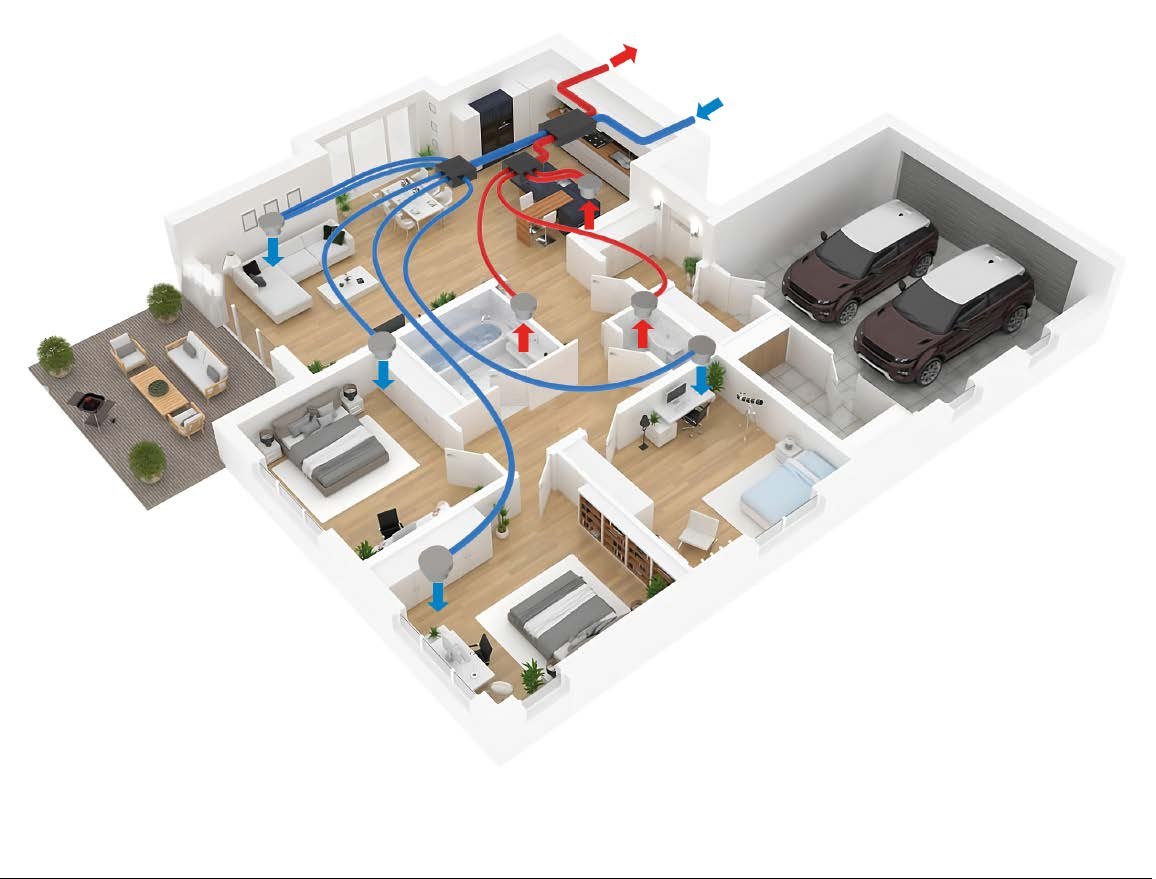
A recovery ventilation unit extracts stale air continuously from the kitchen, bathrooms and laundry, and supplies filtered fresh air to the bedrooms and living spaces. In between, an exchanger passes the energy from the outgoing air to the incoming air, so most of the cooling stays inside.
2
HRV and ERV, side by side
| HRV | ERV | |
|---|---|---|
| Exchanger | Sensible: heat only | Enthalpic: heat and moisture |
| Designed for | Cold, dry climates | Hot and humid climates, including the Gulf |
| Humidity in the fresh air | Passes straight to the room | Largely handed back out with the exhaust air |
| Use in Saudi Arabia | Only where the design specifically calls for a sensible exchanger | The default selection |
In the Gulf, removing humidity is a large share of what a cooling system spends its energy on. That is why the exchanger type matters more here than in Europe, where most of these units are designed.
3
Which size for which villa
| Unit | Max airflow | Usually suits |
|---|---|---|
| WINDY 250 | 250 m³/h | Apartments and small villas |
| WINDY 350 | 350 m³/h | Standard villas |
| WINDY 500 | 500 m³/h | Large villas |
| WINDY 650 | 650 m³/h | Large villas and small offices |
The selection follows room-by-room airflow requirements, not the floor area, so the final unit is sized from the drawings. Full figures for each model are on the heat recovery ventilation page.
4
Where it goes, and the ducting
A ceiling-mounted unit sits above a corridor or a utility ceiling, which is the usual answer in a villa with a service void. A floor-standing unit goes in a plant or service room; a vertical one fits a riser or a store cupboard.
Fresh air runs through Ø75 mm semi-rigid flexible pipe from distribution boxes, small enough for a shallow ceiling void or a screed where rigid ducting will not go. Hidden diffusers set into the plaster and are painted the ceiling colour, leaving only a fine ring slot.
5
If the villa is already finished
- No ducting at all: a single-room unit in the wall, one per room, fitted in an afternoon.
- Some ceiling space or a riser: a ducted unit with Ø75 mm semi-rigid pipe, which fits where rigid ducting will not.
- Schools and offices already built: a unit that stands against the wall like a tall cabinet, with no ducting through the structure.
A site visit decides which.
6
Filters and Riyadh dust
Units carry G4 filters as standard, F7 on the higher ranges. Replacement intervals are published per unit, and we shorten them for Riyadh because of the dust load. Units with a display show when a change is due.
Questions
What villa owners ask
Do I need fresh air if the air conditioning is already running?
Yes. The AC recirculates the air already in the house; it does not bring outside air in or take stale air out.
HRV or ERV for Saudi Arabia?
ERV, for almost every project. It hands much of the humidity in the incoming air back out before it reaches the room. Specify an HRV only where the design calls for a sensible exchanger.
How much will it save on my electricity bill?
It depends on the house, the AC it works alongside and how it is run, so an honest figure needs the project. The mechanism is simple: without recovery every cubic metre of fresh air arrives at outside temperature and humidity; with recovery, most of that load is removed first. We calculate it from the drawings.
Can it be fitted to a finished villa?
Yes: single-room wall units with no ducting, or a ducted unit using Ø75 mm semi-rigid pipe where a ceiling void or riser exists.
Will I see grilles on my ceilings?
No. Hidden diffusers sit in the plaster and are painted over, leaving a fine ring slot.
Related
Where to go next
- Heat and energy recovery ventilation — every model, filter and diffuser
- Central vacuum systems — the other system best installed while the walls are open
- Air Technologies — the whole division