

Protection
EV fire protection systems for car parks in Saudi Arabia
A lithium battery fire is fought from underneath the car, not above it.
A car park sprinkler system is designed to wet a fire from above. An electric vehicle's battery pack sits underneath the car, shielded by the vehicle's own body, and once it enters thermal runaway it produces its own oxygen — so water falling from the ceiling cools the roof of the car while the fire continues beneath it. EV FirePro puts the water where the fire is.
Adding chargers to a basement? Read the guide: EV fires in underground car parks.
It is also searched as EV fire suppression, electric car fire protection for car parks, or an EV battery fire system.
Why it matters
A different fire needs a different response
Electric vehicle battery fires are rare. The concern for a building owner is not the car itself — it is everything around it in an enclosed car park.
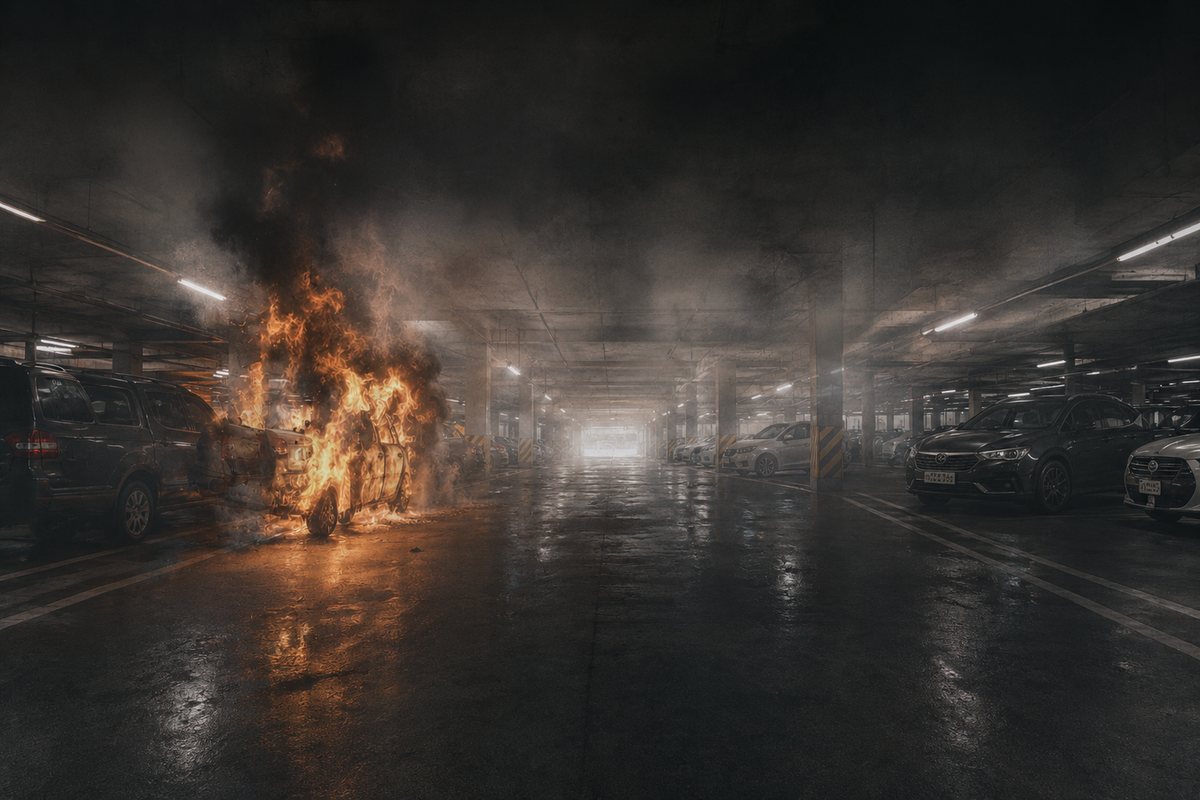
Conventional systems respond from above
Car park sprinklers are designed to wet a fire from the ceiling down. The car body sits between the water and the battery.
The heat source is underneath
An EV’s battery pack sits under the floor of the car, which is exactly where ceiling water does not reach.
EV FirePro targets the heat source
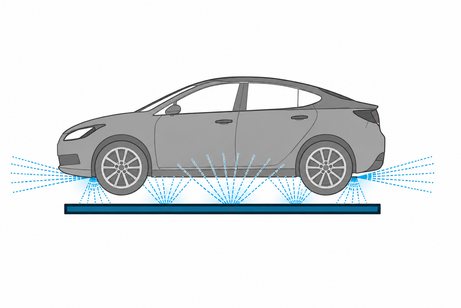
Water is sprayed upwards under the car where the battery is, and outwards to protect the bays and structure beside it.
- Adjacent vehicles parked in the neighbouring bays.
- The charging equipment on the wall or column beside the bay.
- The building itself — slab, columns and services above the car.
- Occupants and tenants using the car park and the floors above it.
- Parking operations and business continuity, which stop for as long as the car park is closed.
The claim, stated exactly
What the system does — and what it does not
The objective is not to extinguish the battery fire
It is targeted under-vehicle cooling and lateral water spray to contain flame spread, protect the structure, and reduce the need for close-range firefighter intervention.
That is the honest description and it is also the useful one. A fire that stays in one bay, in a structure that survives it, with a fire service that can work at a distance, is a manageable incident. A fire that reaches the cars on either side in an enclosed basement is not.
The range was developed in consultation with fire brigades and engineers, and is patented.
What it is
A plate in the bay, not a system on the ceiling
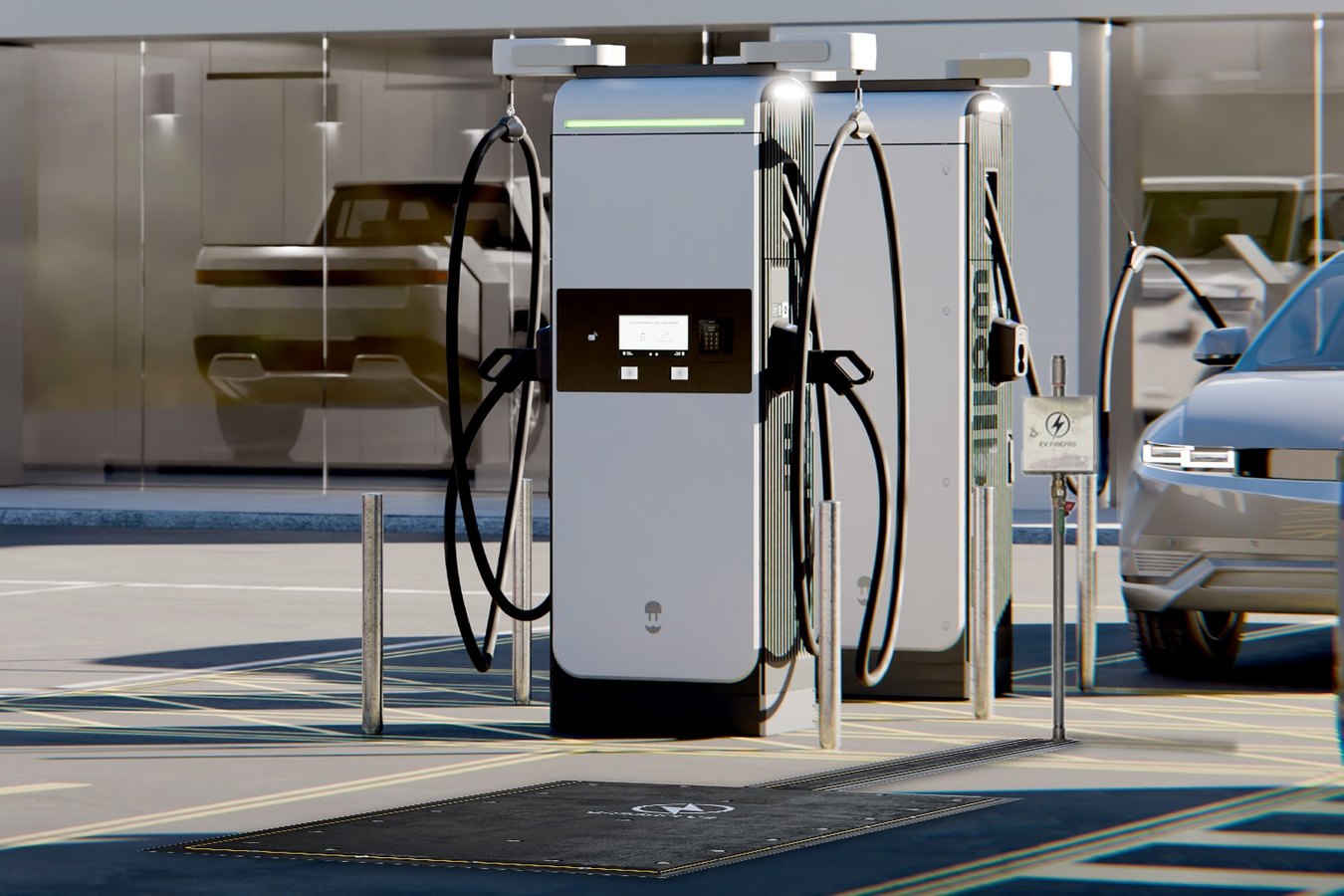
The equipment sits in the parking bay itself. When a battery under a car starts to run away, the water goes where the heat is — underneath the vehicle — instead of onto the roof of a car that is already burning.
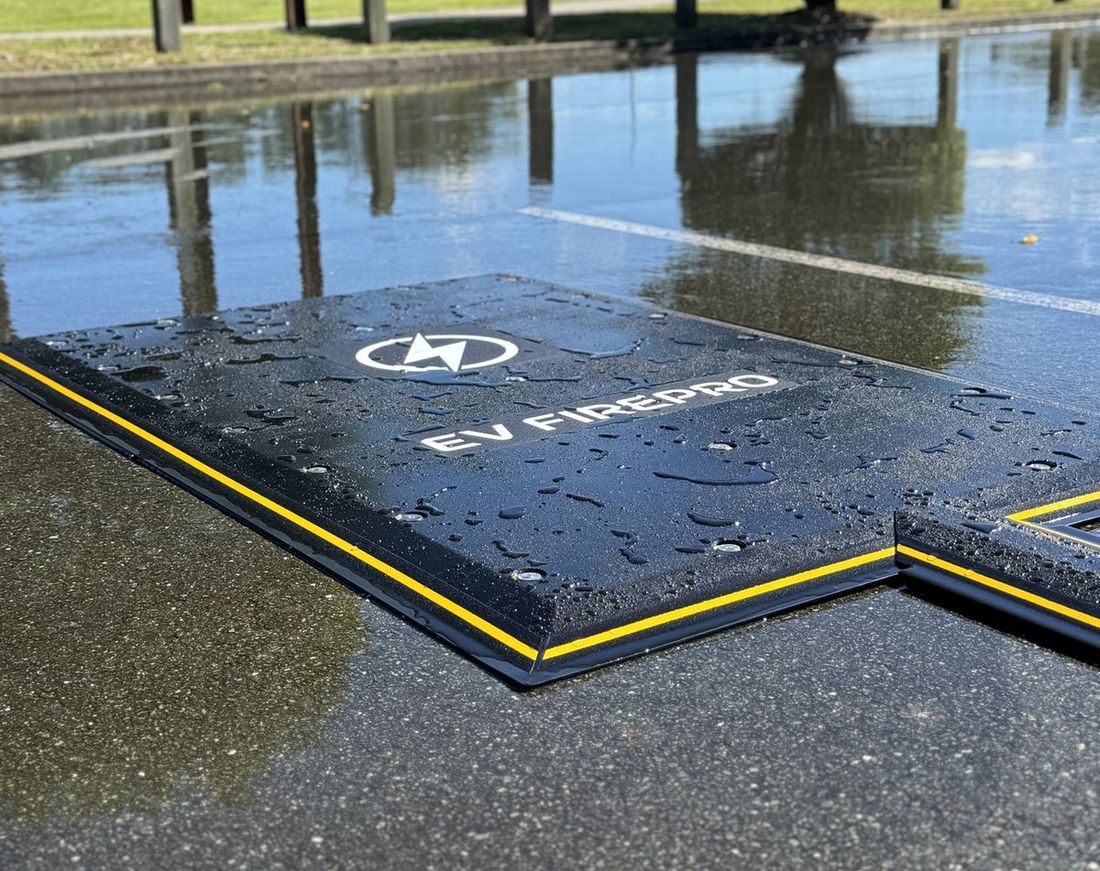
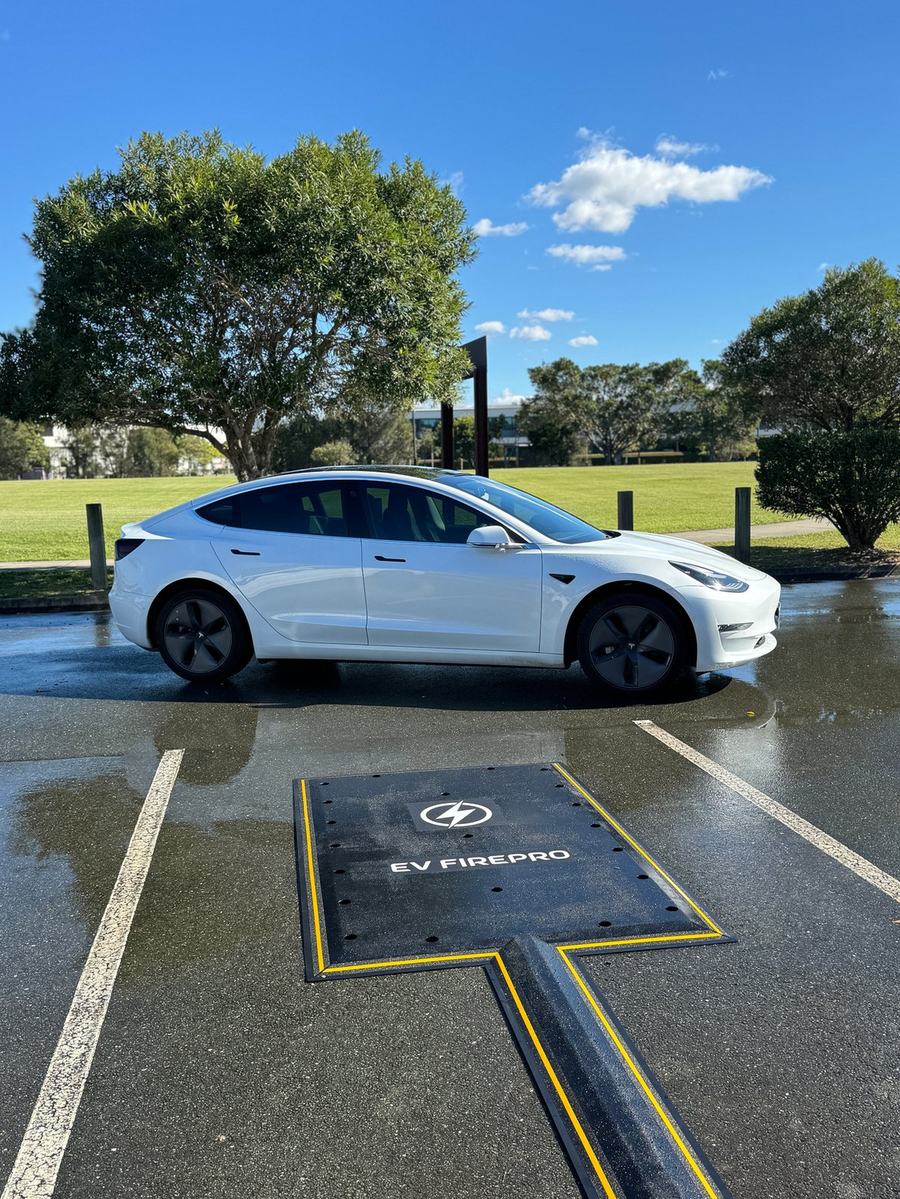
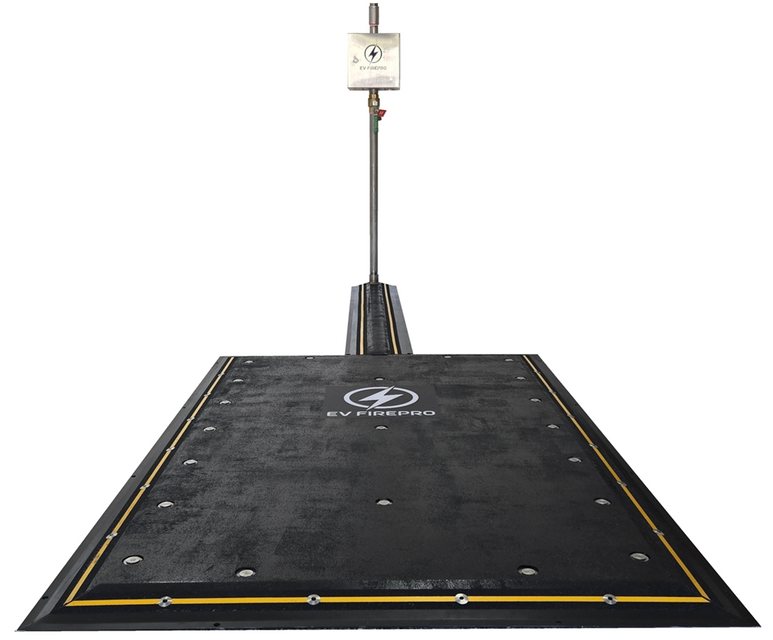
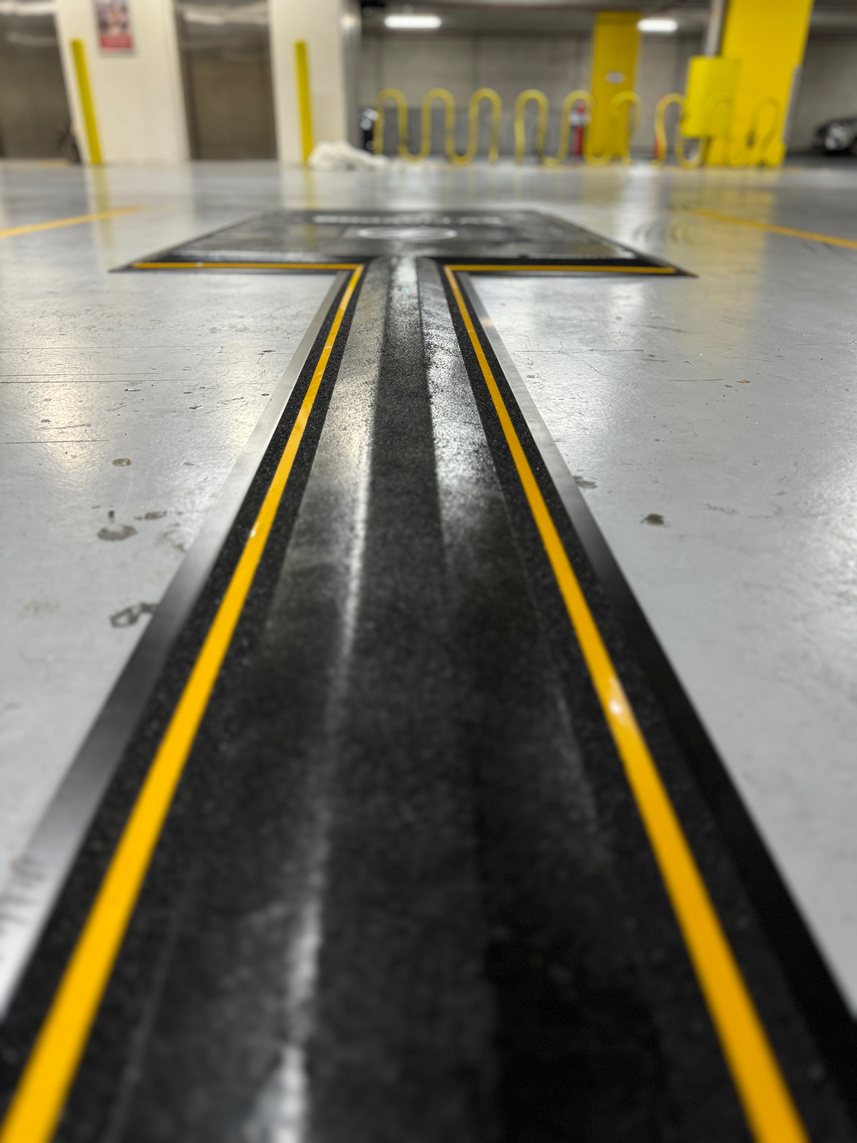
It was engineered specifically for lithium-ion fires in enclosed car parks, in consultation with fire brigades and engineers, and it is designed to do two things a ceiling sprinkler cannot: cool the battery pack directly from beneath, and throw a lateral spray that holds the flame away from the cars on either side. The purpose is to contain the event and protect the structure, and to reduce how close a firefighter has to get.
How it works
What it does, and the six parts that do it
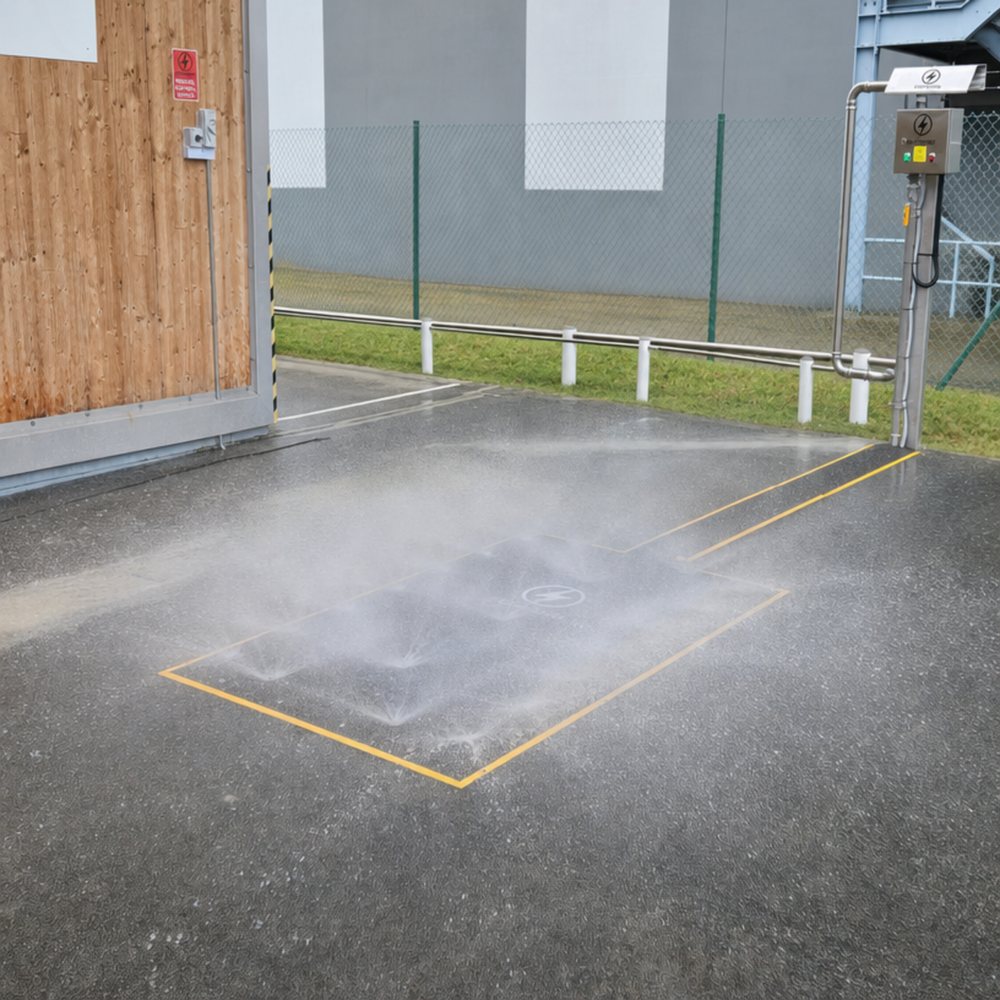
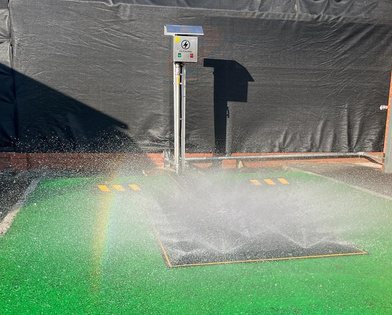
- The plate. A stainless steel cover plate sits flush in the parking bay, 1,990 × 1,270 mm, standing about 30 mm above finished floor level. The car parks over it in the normal way.
- The detection. Linear heat detection wire runs beneath the vehicle with 20 temperature sensing points, activating at 68 °C, 88 °C or 105 °C depending on the wire specified.
- The response. On activation, 7 vertical and 14 lateral nozzles deliver water directly at the battery pack from below. The vertical nozzles cool the pack; the lateral spray holds the fire inside the bay.
- The supply. Roughly 8 litres per second at 750 kPa, with a minimum of 4.75 litres per second at 160 kPa, through a 1½" BSP connection.
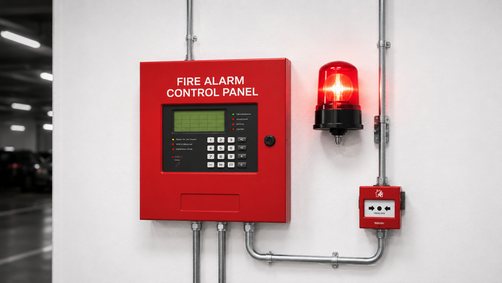
- The interface. A control box connects to the fire alarm panel and the BMS, on 24 V DC with battery backup and an Auto / On / Off selector.
- The material. 304 or 316 marine-grade stainless steel. Specify 316 for the Gulf, and for any coastal or harsh environment.
The range
Four versions, one system
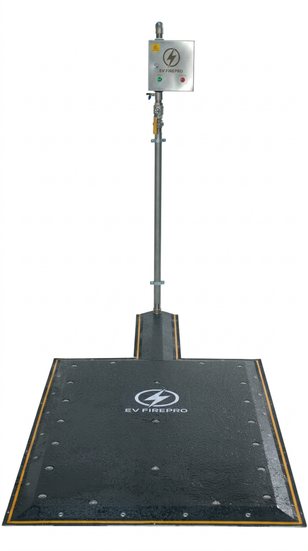
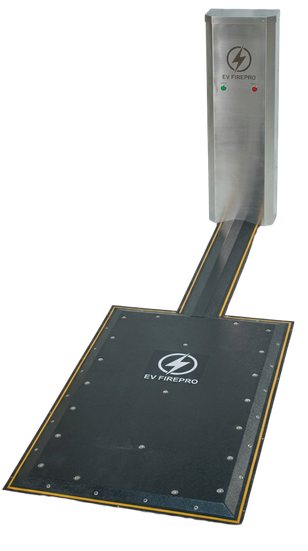
| Version | Built for | Water supply | Integration |
|---|---|---|---|
| Domestic | Villas, private garages and low-rise residential, where a simplified system is the right answer | Dedicated tank and pump | Optional alarm connection |
| Plus | Commercial and multi-level car parks, scaled across several EV bays | Building mains, existing sprinkler or hydrant, or a dedicated tank and pump | Fire alarm panel and BMS — addressable monitoring, alarms and remote control |
| Signature | Premium and architecturally sensitive developments — the same system as Plus, with the control column enclosed | As Plus | As Plus, inside an enclosed control column concealing all pipework and cabling |
| Demonstration unit | A full-scale fixed installation for training, witness testing and technical evaluation by fire brigades, consultants and clients | Standard supply or tank and pump | Connects to an alarm panel for full system simulation |
Plus and Signature interface with the Fire Alarm Control Panel and the Building Management System for addressable monitoring, alarm and remote control. Domestic integrates with a building alarm or control panel.
Why we raise the steel grade before anything else
Every version is built in 304 or 316 marine-grade stainless steel. For a coastal project — Jeddah, Yanbu, Jubail, the Red Sea developments — 316 is the one to specify, and on the Signature it is required rather than recommended, because the finish is part of the product.
This is a cheap decision at specification stage and an expensive one afterwards. It is the first thing we ask about.
Specification
The numbers a fire consultant will ask for
- Cover plate (l × w)
- 1,990 × 1,270 mm
- Height above finished floor
- ≈ 30 mm
- Cover plate material
- 3 mm T304 stainless steel plate
- Pipe frame and spigots
- T304 stainless steel
- Water supply pipe
- 50 mm high-pressure layflat hose
- Infills
- 25 mm glass-reinforced plastic
- Spray nozzles
- 14 lateral, 7 vertical (T304 stainless)
- Optimal flow and pressure
- 8 l/s (480 l/min) @ 750 kPa
- Minimum flow
- 4.75 l/s (285 l/min) @ 160 kPa
- Max. residual pressure
- 1,000 kPa
- Water supply connection
- Male Nb40 (1½″ BSP)
- Temperature sensing points
- 20
- Activation temperature
- Adjustable, 68 °C to 185 °C
- Control enclosure
- 300 × 300 × 200 mm
- Incoming mains
- 110 V AC 15 A – 240 V AC 10 A
- Water valve
- 24 V DC normally-open solenoid, or 24 V DC motorised ball valve
- Fire alarm relay output
- 0 V DC, normally open or normally closed
- Manual control
- 24 V DC three-position selector — Auto / On / Off
Manufacturer's published specification; the system is patented. Cover plate ≈ 62.5 kg, pipe frame ≈ 36.5 kg. The flow and pressure figures are the ones to hand to the hydraulic consultant on day one, because they decide whether the existing supply serves the bay or a tank and pump is needed.
On approvals — read this before you quote us
We will not tell you this product is approved in Saudi Arabia until that approval is in our hands in writing. Acceptance for a given building is settled with the Civil Defence and the project's fire consultant, and it is settled per project.
What we can do today is give you the full specification, the test and performance data from the manufacturer, and the demonstration unit — which exists precisely so that a fire brigade or a consultant can watch the system activate rather than read about it. If your project needs a witnessed demonstration, say so in the enquiry.
Questions
What buyers actually ask
Why doesn't the building's existing sprinkler system handle this?
Because of where the fire is. Sprinklers wet a fire from above, and a battery pack is underneath the car, shielded by the vehicle's own floor. Water from the ceiling cools the bodywork. A battery in thermal runaway also produces its own oxygen, so smothering it is not available as a strategy either — which is why the approach here is cooling and containment rather than extinguishment.
What does thermal runaway actually do, and how long does it burn?
A damaged or failing cell heats its neighbours, which fail in turn, and the reaction sustains itself without needing oxygen from the air. The practical consequences for a building are that it burns far longer than a conventional vehicle fire, it is difficult to approach, and it can reignite after it appears to be out. That is the problem the system is designed around: keep the pack cool, keep the flame in one bay, and keep the fire service at a workable distance.
What does the system protect — the car, or the building around it?
The building, and the people in it. The car is usually a total loss either way. What changes is whether the cars on either side are, whether the structure above is, and whether the fire service can work the incident safely. Be clear about that in any conversation with a client — a supplier who implies the vehicle is saved is setting up a dispute.
Can it come off the existing riser, or does it need its own tank and pump?
Depends on the model and the building. Plus and Signature can be fed from the building mains, an existing sprinkler or hydrant system, or a dedicated tank and pump. Domestic requires a dedicated tank and pump, which is not supplied with the system. The deciding figure is whether the existing supply can deliver the flow and pressure alongside whatever else it is committed to — a question for the fire consultant, and one we will put to them with the figures.
Does it have to be designed in, or can it be retrofitted into an existing bay?
Both are possible. The plate sits on the floor rather than in it, standing about 30 mm proud, so a retrofit does not mean breaking up the slab. What a retrofit does need is a water supply route to the bay and a cable route to the alarm panel, and in an existing basement those two routes are the cost, not the equipment.
Which model for this building?
Residential or a private garage: Domestic. A commercial or multi-level car park, or a transport hub: Plus, because the addressable interface to the fire panel and BMS is what a facilities operation needs. A premium development, a valet operation, or anywhere an architect is involved: Signature, which puts the same system inside an enclosed column with no visible pipework or cabling.
What happens when it activates — who is alerted?
The control box signals the fire alarm panel and the BMS, so activation appears wherever the building's alarms appear and reaches whoever already responds to them. On Plus and Signature the monitoring is addressable, so the panel identifies which bay. The selector on the control box allows the system to be set to Auto, forced On, or isolated — isolation being a maintenance function that belongs under the same control as any other life safety isolation.
Send us your car park layout and fire strategy
We will lay out the protected bays and put the flow and pressure question to your fire consultant.