

Home › Intelligent Connectivity
Field nodes
Solar smart poles and off-grid monitoring nodes for Saudi Arabia
Infrastructure that powers itself, watches the site, and sends what it sees back to the people who can act on it.
This is not a street light with extras. It is a configurable field node: solar power, sensing, local computing and machine interfaces assembled around the job a particular location needs doing. Some of those jobs involve lighting. Many do not. What they have in common is that the node works where it stands — without a grid connection, without a trench, and often before the site has either.
They are also searched as smart street poles, solar CCTV poles or off-grid surveillance poles.
The idea
From a signal to a result
The manufacturer explains it with a single example, and it is better than any specification.
Detect
A gate-side camera detects an obstruction.
Review
The operator reviews its location and recent images alongside the condition of nearby assets.
Task
A fixed view may answer the question; a closer inspection can be requested. The selected team or machine receives a defined task.
Record
Findings return to the event, and the operator records the outcome.
Three words carry it. Location — know where attention is needed. Context — review the information behind the event. Outcome — record what the response achieved. Without that sequence a node is a camera on a pole. With it, the node has an operational role.
The platform
OTATODO
The platform is what makes the hardware worth buying. It links assets, events and tasks: an operator reviews the local context, assigns the right response, and records the result. Energy and equipment states are visible, so the team knows what is ready for work. It connects to the customer's existing operating systems rather than demanding a new one.
The range
Product families
| Family | Form | What it is for |
|---|---|---|
| Sentinel Model B | Cylindrical body with a curved CIGS solar surface | Elevated observation on prominent streets and managed sites. The solar surface follows the pole rather than projecting as a separate panel |
| Sentinel Model C | Four flat photovoltaic faces | Elevated observation where each face carries a defined engineering role |
| Sentinel ME | Compact node, close to the ground | Local environmental and near-ground sensing — landscape edges, facility boundaries, measurement points |
| Sentinel Rapid | Transportable, redeployable | Temporary coverage where the working area changes. Transport, deployment, recommissioning and moving again are designed as one cycle |
| SmartLight | Public-service forms | Lighting with audio, information and physical assistance interfaces. Architectural, coastal, family and destination forms |
| SKYHUB C5 | Eight photovoltaic faces with a service dock | A field base for machines: an aerial dock that receives and services a compatible aircraft including battery exchange, and a ground interface for humanoid robot charging |
Capability
Task packages
The supplier groups capability into four packages rather than a component list, and each carries a decision with it.
| Package | Functions | Decided with it |
|---|---|---|
| Observe | Cameras and perimeter sensing | Views, processing, retention |
| Measure | Environmental instruments | Exposure, sampling, communications |
| Serve | Lighting, information and assistance | Interfaces, content, operating team |
| Operate | Aircraft or robot tasks | A compatible service point, and readiness |
Perimeter and Landscape are function sets configured onto the nodes rather than separate products. Perimeter is about seeing a trigger and then verifying the event. Landscape is about understanding activity across a working area, turning repeated observation into longer-term understanding.
In the Gulf
Where these are used
- Construction and logistics. Fixed nodes on the permanent entrance and boundary; Rapid nodes following the work zone as access roads and material stores move.
- Energy and remote assets. Observation around remote equipment, so that not every question becomes a site visit.
- Inspection with a defined purpose. Fixed sensing gives the first context; a closer inspection answers the specific question that remains.
- Public spaces and destinations. Waterfronts, hospitality districts and transport arrival areas — arrival guidance, a lit route, local announcements and physical assistance points along the visitor's actual route.
- Environment, farms and conservation. Compact ME nodes and elevated observation across a managed landscape.
How we quote
What we need from you
The manufacturer works from a project brief rather than a product list, and so do we.
| Place | Country, site plan, proposed positions |
| Purpose | The functions and operating outcomes required |
| Conditions | Energy, connectivity, access, environment |
| Programme | Quantity, timing, delivery scope |
What comes back is a configuration schedule, arrangement drawings, foundation and routing information, equipment interfaces, commissioning procedures, operator workflows and maintenance requirements.
If you send us a request for a price per pole, we will send you these four questions — because a node configured for a hotel forecourt and one configured for a construction boundary share a mast and nothing else.
A note on the aerial dock
SKYHUB C5 is a field base: it receives and services a compatible aircraft, including battery exchange, and provides a ground interface for robot charging. Operating an aircraft in Saudi Arabia is separately licensed by the aviation authority, and that licence is the operator's, not the equipment's.
We supply and commission the field base. We do not fly anything, and we are careful not to imply otherwise.
The hardware
Six series, one module library
Every series is built on the same pole platform and draws from the same module library. That is what makes the range worth treating as one product rather than six.
| Series | What it is | Typical fit |
|---|---|---|
| Wind + solar hybrid | The off-grid working pole: vertical-axis wind turbine, solar, LED street-light head, 4K PTZ camera, environmental sensing, information display, one-touch SOS, USB and EV charging, on a lattice steel base. | Sites with no grid, construction boundaries, perimeter roads, remote facilities |
| Architectural photovoltaic | A thin-film photovoltaic body that is the façade rather than a panel bolted to one — with a transparent display, a 360° crown light, directional audio, wireless charging and 7 or 22 kW EV charging. | Hotel frontages, retail streets, anywhere the pole has to be looked at |
| Family and children | A child-safe service point with a touch screen, camera, emergency call and charging, built to the European playground-equipment safety standard. | Parks, family districts, shopping destinations |
| Sky hub | A pole with an open drone landing pad, edge-AI computing, RTK base station, 5G mmWave and a locker compartment. | Large sites where inspection and delivery happen by air |
| Heritage landmark | A monument-pole with a pixel-skin LED panel, directional audio, AR and NFC trigger plates, and a sensor pod measuring footfall, vibration and corrosion. | Historic districts, cultural destinations, public realm |
| Selfie tower | A visitor-facing photo structure with multiple 4K cameras, a 43″ outdoor touch screen and NFC stamp points. | Destinations that need to be shared rather than only visited |
All six draw from a module library of seventy-plus items, so the series is a starting form rather than a fixed product.
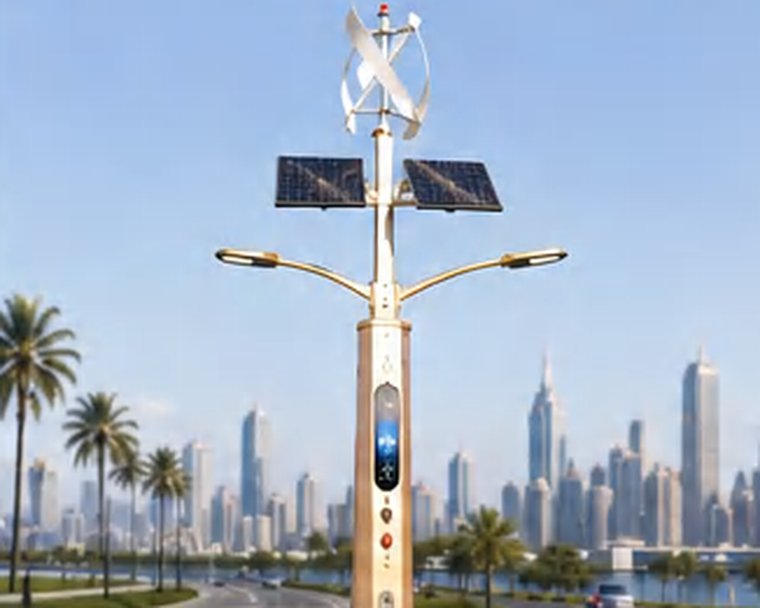
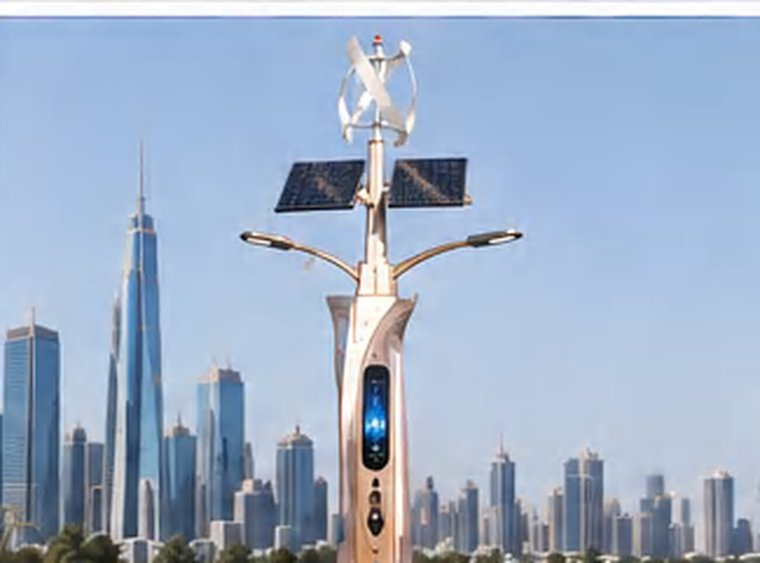
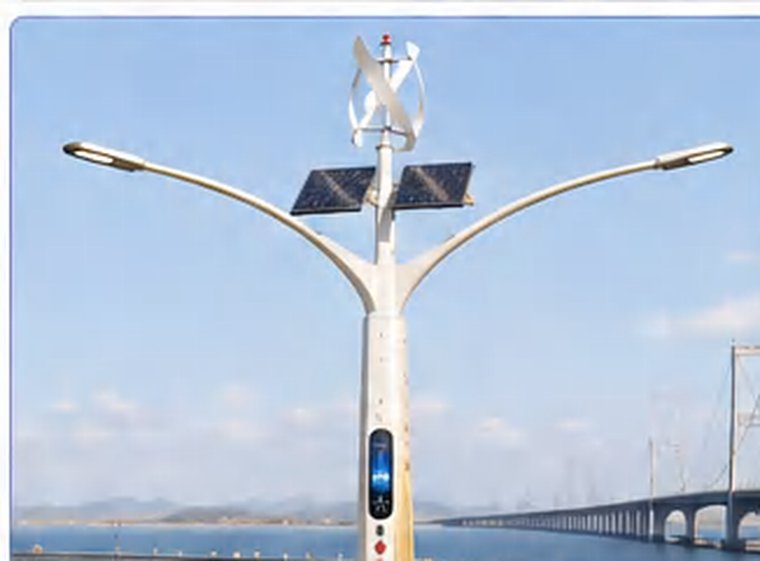
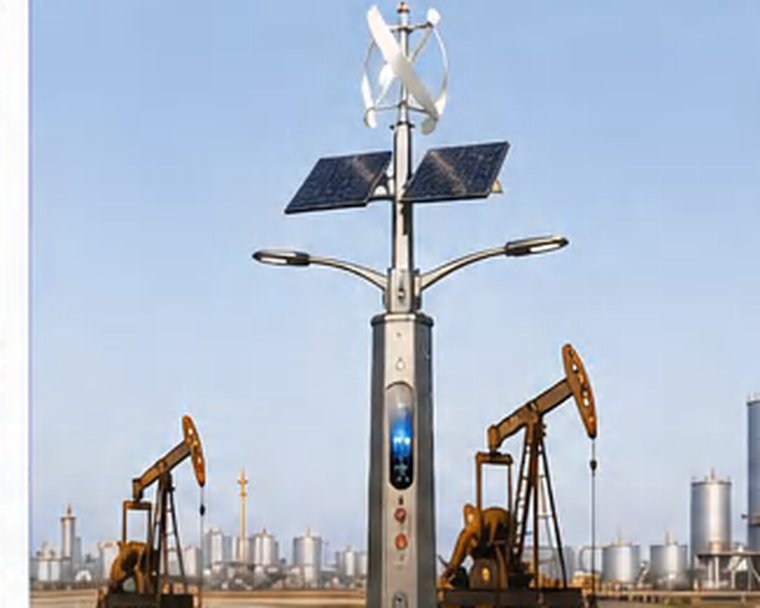
Manufacturer's product illustrations. These are not photographs of Centra installations, and we will not present them as such.
Choosing a form
Height, power and where each one belongs
The pole form is chosen from working height, wind and solar yield at the site, and what the mast has to carry — in that order.
| Form | Height | Wind | Solar | Typical setting |
|---|---|---|---|---|
| Square compact | 6 m | 600 W | 200 W | Rural and residential streets |
| Octagonal standard | 8 m | 1 kW | 400 W | Urban and coastal boulevards |
| Tapered round | 10 m | 1 kW | 800 W | Plateau and mountain roads |
| Heavy octagonal | 12 m | 3 kW | 600 W | Heavy industrial and oilfield |
| Signature | 14 m | 5 kW | 1 kW | Signature city routes |
| Lattice tower | 16 m | 7 kW | 1 kW | Maximum off-grid generation |
| Y-fork twin-head | 12 m | 3 kW | 800 W | Coastal highway and port roads |
| Cold-sealed | 10 m | — | 800 W (cold spec) | Sealed build for extreme low temperature |
Manufacturer's published configurations, each carrying around ten modules. Generation figures are nameplate ratings — what a given site will actually produce comes from its own wind and irradiance data, and that calculation is part of the engineering work rather than a line in a brochure.
The module library
- Energy — vertical-axis wind turbine, monocrystalline solar, lithium iron phosphate battery, MPPT charge controller
- Lighting — LED street-light head, crown and architectural lighting
- Sensing — 4K AI camera, 60 GHz millimetre-wave radar, eight-in-one weather station, footfall, vibration and corrosion sensing
- Communications — 5G micro-cell and mmWave, satellite uplink, RTK base station, edge-AI compute
- Public interface — information display, IP65 speaker, one-touch SOS, USB-C charging, NFC and AR trigger plates
- Protection — Class B + C lightning surge arrester, environmental sealing specified against the site
Two things to be straight about
Generation numbers are site numbers. A pole rated at 3 kW of wind does not produce 3 kW; it produces what the wind at that location gives it. We will size the battery and the duty cycle from your site's data and the equipment you want running, and we would rather give you a smaller honest figure than a larger useless one.
Drone operations are licensed separately. We supply and commission the sky-hub field base, including battery exchange and the ground service interface. Flying in the Kingdom is authorised by the competent authority and that authorisation belongs to the operator, not to the equipment. We do not fly anything, and we are careful not to imply otherwise.
Questions
What buyers actually ask
Can a site be watched and lit before the grid reaches it?
That is the main reason to buy one. The node generates and stores its own power and communicates over whatever path the site has, so observation and lighting arrive with the first phase of work rather than after the substation. On a district development it means the perimeter is covered during construction, which is when it matters most.
What does a node actually send back, and who sees it?
Images and sensor readings selected by the configuration, to the operations platform, visible to whoever your roles allow. It is not a video wall by default — the design question is which views and which measurements earn their bandwidth and their storage, and that is settled with you rather than assumed.
What happens when it detects something — who is told, and what do they do?
An event is raised with its location and recent context, an operator reviews it, a defined task goes to a team or a machine, and the finding returns to the event record. The part that makes this work is deciding in advance who owns which category of event. A system that raises alerts into an unstaffed inbox is a liability rather than an asset.
How long does it run without sun?
The reserve is designed from the operating schedule and the selected equipment, not the other way round — a node running lighting and continuous imaging has a different energy arrangement from one taking environmental readings at intervals. Tell us the duty and we will tell you the reserve. Treat a supplier who quotes autonomy days without asking what the node is doing as having designed a different node.
Which node suits a construction site, and which suits a hotel forecourt?
A construction site usually takes fixed nodes at the permanent entrance and boundary plus Rapid nodes that move with the work zone. A hotel forecourt takes SmartLight, which is where the public-service forms and the architectural treatments belong. The mast is the only thing they share.
Can a node be moved when the work area changes?
Rapid is designed for exactly that — transport, deployment, recommissioning and moving again as one cycle, rather than as a decommissioning and a new installation.
What happens to a pole in a sandstorm, and in 50 °C?
Thermal and environmental design is a defined part of the engineering rather than an afterthought, and it is specified against the site's actual conditions. This is a question to put to us with the site's location and exposure, and we will put it to the manufacturer with the figures. We would rather give you an engineered answer than a reassuring one.
Who owns the data, and where is it stored?
You own it. Where it is hosted is a design decision taken with you, and in-Kingdom hosting is specified where you require it. Cameras, people counting and analytics in a public setting are personal data processing under Saudi data protection rules, so retention, access and the lawful basis belong in the design — and for a municipality or a government authority, this question usually decides whether the conversation continues. We would rather answer it on page one.
Can it connect to the systems we already use?
The operations platform is built to connect to a customer's existing operating systems rather than replace them. What that means in practice depends on what you run, so it is scoped against your systems rather than promised in the abstract.
Send us the four inputs
Place, purpose, conditions, programme. What comes back is a configuration schedule.