

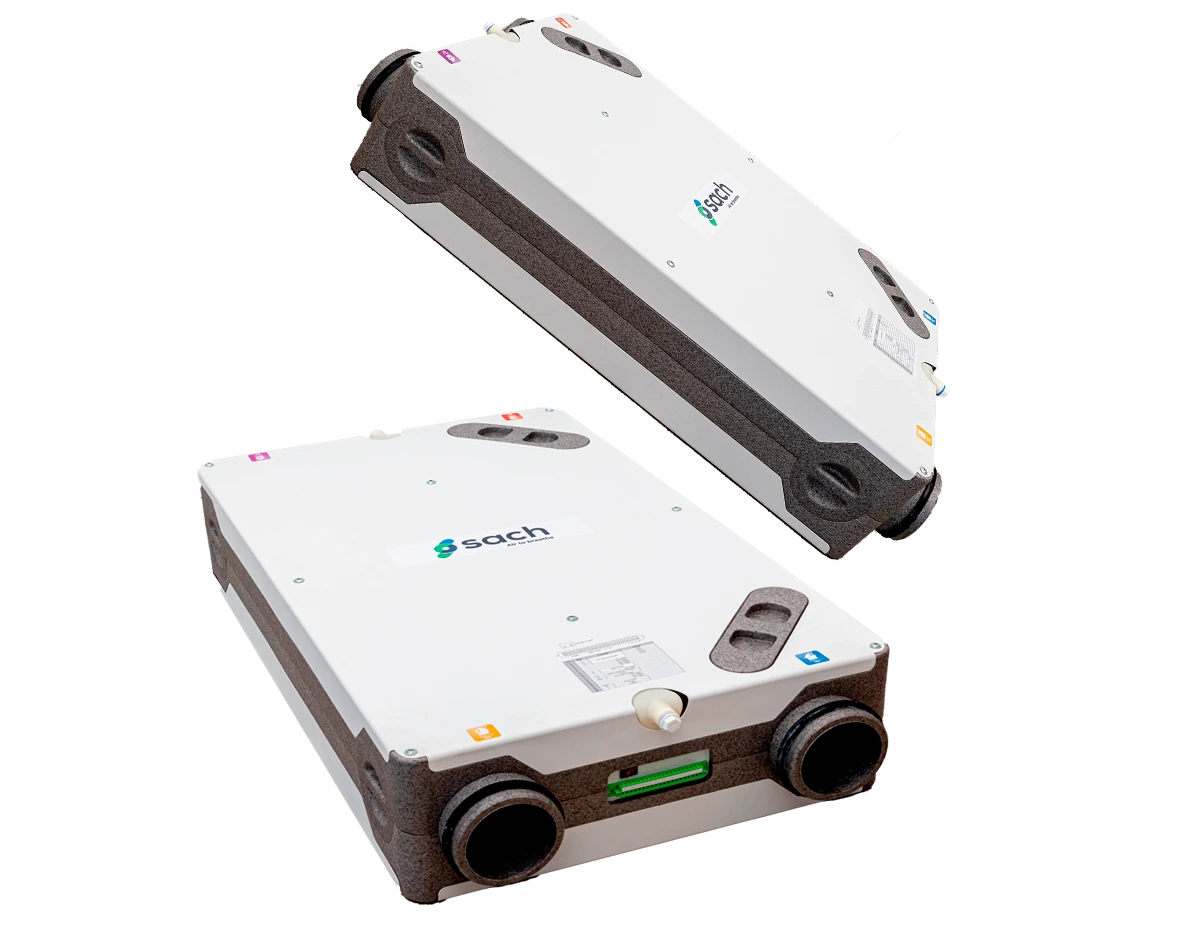
Does heat recovery ventilation actually work in Riyadh heat?
Yes, and the hotter it is outside the more it does.
Heat recovery works on the temperature difference between the two air streams. In a European winter that difference is used to warm incoming air. In Riyadh it runs the other way: indoor air leaving at around 22 degrees pre-cools outdoor air arriving at 45, so the air conditioning receives air that has already had a large part of the heat taken out of it.
The bigger the gap between outside and inside, the more there is to recover. Gulf summers are close to the ideal case for the technology, not a problem for it.
How is HRV different from air conditioning?
They do different jobs and a building generally needs both.
Air conditioning takes the air already in the room, cools it, and returns it. Left alone, that air gets steadily staler: carbon dioxide from the people in it, humidity, cooking smells, and the off-gassing of furniture and finishes all build up, because nothing is being removed.
Ventilation replaces that air with fresh air from outside. Opening a window does it, at the cost of letting in 45 degree air and dust. HRV does it continuously, filtered, and with most of the temperature penalty removed.
The short version: air conditioning controls temperature, ventilation controls air quality. A well-sealed modern building needs the second one designed in, because it will not happen by accident.
Does HRV reduce cooling load?
It reduces the part of the cooling load that comes from ventilation air, which in a building that ventilates properly is a significant share of the total.
Every cubic metre of fresh air a building brings in has to be cooled from outdoor temperature to indoor temperature. Pre-cooling that air through a heat exchanger means the chiller or split system does less work for the same amount of fresh air.
What it does not do is reduce the load from sun through glazing, from occupants, or from equipment. It is not a replacement for insulation or for correct AC sizing, and it should not be specified as one.
What about humidity in Jeddah and Dammam?
This is the question that separates a good specification from a bad one.
A standard heat exchanger transfers heat, not moisture. In dry inland conditions like Riyadh that is fine. On the coast, where outdoor air carries a heavy moisture load, transferring the heat but not the humidity leaves the air conditioning to do all the dehumidification.
Energy recovery ventilation, sometimes called enthalpy recovery, transfers part of the moisture as well as the heat, which suits humid coastal conditions better.
Which of the two a coastal project needs depends on the site, and it is worth settling at design stage rather than finding out after handover that the air conditioning is doing all the dehumidifying.
How much ventilation does a building need?
Ventilation rates are set per space, driven by how many people use it and what happens there. A bedroom, an open-plan office and a commercial kitchen have very different requirements, and the total for the building is the sum of its rooms rather than a single figure applied to the floor area.
Centra works the rates out from the drawings, room by room, and returns duct sizing and unit selection with the bill of quantities.
When does HRV need to be designed in?
At design stage, with the rest of the mechanical services. HRV needs duct routes to and from every space it serves, a position for the unit with access for filter changes, and coordination with the AC design so the two are not working against each other.
Centra installs HRV in both new and existing buildings. In an existing building the question is whether duct routes can be created to the spaces being served, which is what a site visit establishes. It is more involved than installing during construction, for the same reason central vacuum is: the ductwork needs a continuous route, and in a finished building those routes mostly do not exist yet.