

How does a central vacuum system work?
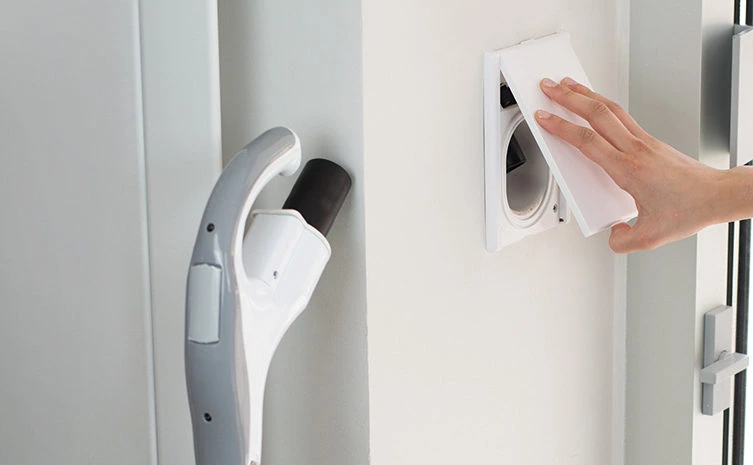
The system has three parts. A power unit, mounted away from living areas, generates suction and collects debris in a canister. A network of rigid tubing runs through walls, ceilings or service voids to each part of the building. Inlet valves sit flush in the wall wherever you need to clean.
Opening an inlet valve starts the power unit automatically. Dust and debris travel through the tubing to the canister, which is emptied periodically. Where the exhaust is vented outside the building, fine particles leave the house entirely rather than being returned to the room, which is the main air quality difference compared with a portable machine.
How many inlets does a villa need?
Inlet count is set by hose reach, not by floor area alone. Each inlet needs to cover the area a person can reach with the hose while it is plugged in, so the number depends on the hose length and on how the building is divided. A long open floor plate needs fewer inlets than the same area split into many rooms with narrow doorways.
In practice the placement is worked out from the floor plan rather than estimated from a total. Inlets go where the hose can reach the corners of every room it serves, corridors are covered from a single point where possible, and stairs are handled from the landing above. Centra's engineering team works this out from the drawings before anything is quoted.
Can a central vacuum system be installed in an existing building?
Yes. Centra installs in both new and existing buildings, although retrofitting is more involved than installing during construction, and how much more depends on the building.
The tubing needs a continuous route from every inlet back to the power unit, so the work is straightforward where there are accessible service voids, a roof space, a basement, or vertical risers already in place. It is more disruptive where every run has to be chased into finished walls.
In an existing villa the usual approach is to run the main line through whatever void exists and place inlets on walls that back onto it, which sometimes means fewer inlets than a new build would have, positioned differently. A site visit establishes what is achievable before any commitment.
At what stage of construction is the piping installed?
At first fix, alongside the other services, before walls are closed. The tubing is run and capped, the inlet positions are set, and the power unit location is fixed. Final fitting of the valves and the unit happens at second fix.
This is the most useful thing to know early, because deciding to add central vacuum after the walls are up turns a simple installation into a retrofit. On projects where the decision is still open, the piping can be installed and capped so the option stays available without committing to the rest of the system.
How is it different from a portable vacuum cleaner?
Three practical differences, aside from the air quality point above.
- Nothing heavy moves between floors. You carry a hose, not a machine. In a villa over several floors this is the difference people notice first.
- The noise is not in the room. The motor is in the garage or service room, so cleaning is quiet where you are standing.
- Suction does not depend on a small onboard motor. The power unit is sized for the whole building rather than for portability.
The trade-off is that it has to be designed into the building. A portable machine can be bought this afternoon; a central system is part of the construction.
Specifying central vacuum on a project
For developers and consultants, the two decisions that matter at design stage are where the power unit sits and whether the tubing route is coordinated with the other services before first fix. Both are easier to resolve on the drawing than on site.
Centra reviews project drawings and returns inlet placement with a bill of quantities, then handles installation, testing and handover, with ongoing maintenance support afterwards.